A Christian Tech Reset for People Who Cannot Fully Switch Off
A Christian tech reset can help tech workers, founders, parents, and on-call professionals practice real rest without pretending emergencies do not exist.
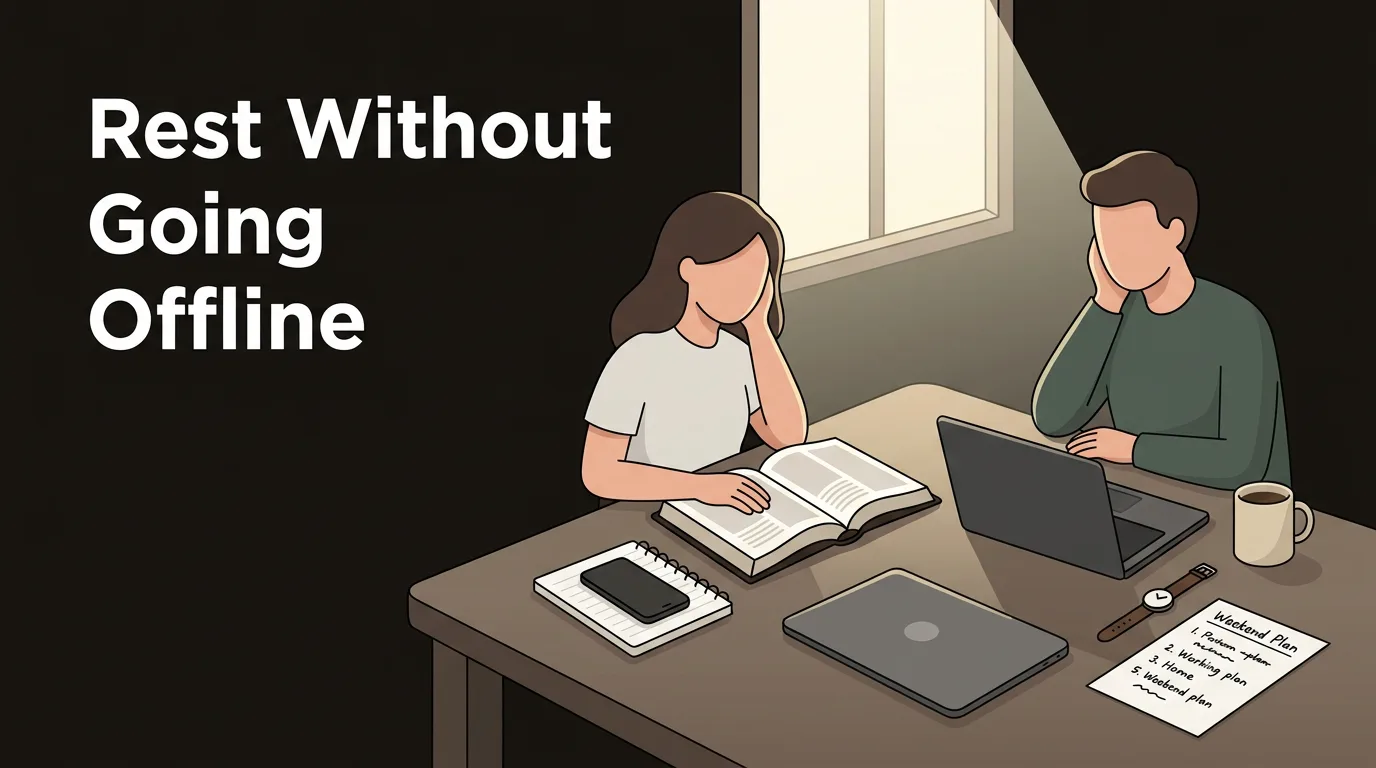
A Christian tech reset is not a fantasy for people with empty calendars. It is a way of receiving limits from God when your work, family, and devices keep asking for more. For tech workers, founders, busy professionals, and parents who stay half-alert for the next ping, rest often feels noble in theory and impossible in practice. But Scripture offers a deeper picture of rest, not escape, but trust.
Why rest feels harder when your phone is your office
If your phone carries Slack, email, incident alerts, school messages, banking apps, maps, and family logistics, turning it off can feel irresponsible. Many people are not addicted to entertainment alone. They are carrying responsibility in their pocket. That is why shallow advice does not help. You do not need guilt. You need a clear plan for sabbath rest that makes room for real obligations and honest human limits.
"It is useless for you to work so hard from early morning until late at night, anxiously working for food to eat, for God gives rest to his loved ones." - Psalm 127:2
The theology of rest for people with real responsibilities
In Scripture, Sabbath is not first a productivity hack. It is a confession. When we stop, even briefly, we are saying, God is God, and I am not. The world keeps turning while we sleep. Systems keep moving while we pray. Some things remain unfinished. That discomfort is part of the practice.
For knowledge workers, this matters deeply. Our labor is often invisible, mental, and endless. There is always one more decision, one more draft, one more message to answer. Christian rest teaches us to put a boundary around what could otherwise become infinite work.
Rest is not laziness
Biblical rest is active trust. It may include worship, a slow meal, a walk, reading Scripture, or being fully present with your spouse, children, or friends. It is not merely collapsing on the couch with three hours of numbing content. A technology fast can help because it removes the tools that keep pulling your mind back into low-grade vigilance.
What the first few hours usually feel like
Be honest about the cost. In the first two or three hours, you may feel FOMO, irritability, or background anxiety. You may wonder who needs you. You may keep reaching for your pocket out of habit. This does not mean the practice is failing. It often means your nervous system is noticing how tethered it has become.
- Expect a rise in inner noise before you feel peace.
- Write down any task you are afraid to forget, so your mind does not keep rehearsing it.
- Tell key people ahead of time what your availability will be.
- Choose one calming activity for the transition, such as a walk, printed reading, or making lunch slowly.
- If you are trying a no phone day, start smaller if needed and build up.
Three realistic versions of a Christian tech reset
1. The half-day reset
This is often the best starting point for people who are on call, parenting small children, or carrying leadership responsibility. Pick a half day each week, perhaps Saturday morning or Sunday afternoon. Remove social apps, news, work chat, and browsing. Keep only maps, calls from favorites, and one emergency contact path.
- Set an auto-reply for email or chat if needed.
- Tell one teammate how to reach you for true urgent issues.
- Put your phone in another room for 60 to 90 minute stretches.
- Plan one life-giving activity before the reset begins.
- End the half day with 10 minutes of reflection: What felt hard? What felt healing?
2. The full-day practice
A full day of sabbath rest works best when it is planned, not improvised. Decide in advance what is off-limits: work apps, social media, shopping, doomscrolling, and unnecessary email. Decide what is welcome: worship, rest, meals, naps, books, conversation, creation, and delight. A full-day technology fast is less about rules for their own sake and more about making room for attention to return to God and neighbor.
3. The weekend variant
A full weekend is not possible every week, but it can be powerful once a month or once a quarter. Founders and high-responsibility workers often need a wider runway before their mind settles. If you try this, create a shutdown ritual on Friday: clear your desk, send final updates, name who owns emergencies, and write Monday's first three tasks so they do not follow you around mentally.
How to handle real emergencies during sabbath
This is where many people give up before they begin. They assume rest means being unreachable. Usually it does not. The wiser goal is narrow availability. Keep one clear emergency path and close the rest.
- Choose one channel for emergencies only, such as calls from starred contacts or one on-call app.
- Define emergency in advance. A true emergency is not 'someone hopes for a quick answer.'
- Ask a teammate or family member to triage non-urgent messages.
- Turn off previews so you do not get pulled in by partial information.
- If an emergency truly happens, respond simply, then return to rest without spiraling into general checking.
For parents, this may mean grandparents can call but group chats stay muted. For on-call workers, it may mean incident alerts remain on while email and Slack are blocked. The principle is simple: make exceptions narrow, visible, and pre-decided.
Want help creating a prayerful phone boundary?
Prayin lets you lock distracting apps behind a 60-second prayer, so checking your phone becomes a moment of attention, not reflex. It is a gentle way to support a Christian tech reset without shame.
Install PrayinA simple rhythm for your first month
If this is new, do not begin with an extreme plan. Start with one half-day each week for four weeks. During that time, notice what keeps calling to you. Is it work fear, loneliness, boredom, or the need for stimulation? Those moments can become prayer.
- Week 1: lock social apps for a half day.
- Week 2: add email and news.
- Week 3: add a brief planning ritual before the reset begins.
- Week 4: practice one hour of phone-free presence with family, friends, or God alone.
"Come to me, all who labor and are heavy laden, and I will give you rest." - Matthew 11:28
When rest feels unproductive
Many high-capacity people feel uneasy when nothing measurable is happening. That is understandable. But some forms of exhaustion cannot be solved by optimizing harder. Sometimes the faithful next step is to stop proving your usefulness for a few hours and receive your life as a gift. That is part of a Christian tech reset too.
Frequently asked
What is a Christian tech reset?
A Christian tech reset is a planned period of reduced phone and app use that helps you practice prayer, attention, and rest before God.
Can I practice sabbath rest if I am on call?
Yes. Use narrow availability instead of total disappearance. Keep one emergency path open and block everything else.
How long should a technology fast be?
Start with a half day if a full day feels unrealistic. Consistency matters more than intensity at the beginning.
What if I feel anxious during a no phone day?
That is common in the first few hours. Expect discomfort, write down worries, and move slowly through it rather than treating it as failure.
Start your trial
The apps that pull at you stay quiet until you pray. Christian screen-time, built on Apple Family Controls.
Install Prayin Lock